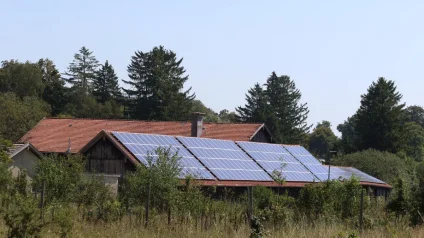
TOPCon solar technology has become the dominant photovoltaic standard worldwide, overtaking PERC cells thanks to higher efficiency, lower degradation, and strong market adoption.

How TOPCon solar technology became the new industry standard
TOPCon solar technology (Tunnel Oxide Passivated Contact) has emerged as the leading photovoltaic technology, ending the long-standing dominance of PERC (Passivated Emitter and Rear Cell) solar cells.
According to recent industry data, TOPCon increased its market share from 10% in 2022 to around 30% in 2023, when PERC still accounted for 64% of global shipments. By 2024, the situation had reversed, with N-type TOPCon cells surpassing the 50% threshold. Current projections indicate the technology will account for more than 70% of the global solar market.
Its rapid adoption reflects the solar industry’s search for higher efficiencies, improved durability, and lower long-term energy costs. These factors are increasingly relevant in fast-growing solar markets across Africa, Asia, Europe, and the Americas.
What is TOPCon solar technology?
Developed by the Fraunhofer Institute for Solar Energy Systems (ISE) in 2013, TOPCon introduces a modified cell architecture designed to reduce charge-carrier recombination while improving electron transport.
The technology adds two key layers to a conventional crystalline silicon solar cell:
- An ultra-thin tunnel oxide layer
- A heavily doped polycrystalline silicon layer
The tunnel oxide layer, typically just 1-2 nanometers thick, passivates the silicon surface and minimizes recombination losses. At the same time, its extreme thinness allows electrons to pass through via quantum tunneling.
Above it, the polycrystalline silicon layer improves electrical conductivity and reduces transport losses, contributing to higher overall cell performance.
Why N-type TOPCon is outperforming P-type technologies
Like other photovoltaic technologies, TOPCon cells can be manufactured using either P-type or N-type silicon wafers.
For years, P-type cells dominated the solar sector because they were easier and cheaper to produce. However, manufacturers are increasingly shifting toward N-type TOPCon because it delivers superior performance.
N-type cells offer:
- Lower susceptibility to power-induced degradation (PID)
- Better temperature performance
- Reduced sensitivity to metallic impurities
- Lower light-induced degradation (LID)
These advantages make N-type TOPCon particularly attractive for utility-scale solar projects operating in hot climates, including many regions across Sub-Saharan Africa.
Key advantages of TOPCon solar technology
The technology’s market success is driven by several technical benefits.
Lower recombination losses
The tunnel oxide layer significantly reduces electron-hole recombination, allowing more charge carriers to contribute to electricity generation.
Improved charge collection
The polycrystalline silicon layer provides a low-resistance pathway for electrons, increasing collection efficiency.
Higher voltage output
Reduced recombination losses result in a higher open-circuit voltage (Voc), improving overall cell performance.
Higher conversion efficiency
TOPCon currently represents the highest-efficiency commercially available crystalline silicon technology. Leading manufacturers have achieved cell efficiencies exceeding 26%, compared with approximately 23.2% for traditional PERC cells.
Lower degradation rates
Because N-type TOPCon uses phosphorus-doped silicon rather than boron-doped substrates, it avoids boron-oxygen related recombination centers that typically contribute to performance degradation.
How TOPCon differs from PERC
Compared with PERC manufacturing, TOPCon production requires additional processing steps, including:
- Deposition of an ultra-thin silicon dioxide tunnel oxide layer
- Deposition of a polycrystalline silicon passivation layer
- Phosphorus doping processes
While manufacturing complexity is slightly higher, the resulting performance improvements have convinced most leading solar manufacturers to transition their production lines toward TOPCon.
Record efficiency milestones
In February 2026, researchers from several universities together with Jinko Solar scientists developed an industrial-scale TOPCon solar cell based on an M10 silicon wafer that achieved a world-record conversion efficiency of 26.66%.
The team improved both sides of the cell:
- High-resistance boron emitters and optimized front-side grids enhanced surface passivation and carrier transport.
- A silicon-polysilicon shielding structure on the rear side reduced metallization-induced degradation.
- Localized thinning of the polysilicon layer improved rear transparency and bifacial performance.
The result was a cell featuring:
- 26.66% conversion efficiency
- 744.6 mV open-circuit voltage (Voc)
- 85.57% fill factor (FF)
- 88.3% bifaciality
These figures currently represent the highest reported performance for industrial TOPCon technology.
Remaining degradation challenges
Despite its strengths, TOPCon technology still faces some reliability challenges.
A recent study by the Fraunhofer Institute for Solar Energy Systems (ISE) evaluated 20 TOPCon photovoltaic modules from different manufacturers and identified degradation mechanisms linked to humidity and ultraviolet (UV) exposure.
During accelerated aging tests, researchers observed a new degradation pattern. Indoor UV exposure caused power losses of up to 12% after 120 kWh/m² of irradiation. Some performance recovery occurred following damp-freeze testing, suggesting complex interactions between environmental stress factors.
Humidity-related degradation appears to be associated with the conductivity sensitivity of metallization pastes. Researchers believe future module generations may significantly reduce these effects.
The findings highlight the need for more targeted testing procedures and further technology refinement.
Reducing silver consumption in TOPCon cells
Another important area of innovation involves reducing silver use.
Fraunhofer ISE researchers recently developed a low-silver TOPCon architecture requiring only 1.1 mg/Wp of silver, compared with the typical 10-12 mg/Wp used in conventional TOPCon contacts.
The breakthrough was achieved through a new inline metallization process that dramatically cuts silver demand without sacrificing efficiency.
Why silver matters
Silver paste currently accounts for more than 50% of the wafer-to-cell conversion cost.
This cost pressure is amplified by volatile precious-metal markets. After a sustained increase beginning in late 2025, silver prices reached around USD 79 per ounce after peaking at USD 116 per ounce in January 2026.
Supply constraints and long-term availability concerns could increase module costs and push up the Levelized Cost of Energy (LCOE).

Hybrid metallization approach
To address this challenge, Fraunhofer ISE and RENA Technologies GmbH developed a hybrid process combining laser structuring and electroplating.
The architecture uses:
- Nickel as a barrier against copper migration
- Copper for electrical conductivity
- A minimal amount of silver for oxidation protection
Tests on industrial production lines produced M10 solar cells with:
- 24% efficiency
- 82.1% fill factor
These values are comparable to conventional screen-printing technologies, while degradation testing under IEC 61215 standards confirmed long-term stability.
When will low-silver TOPCon reach the market?
According to Fraunhofer ISE electrochemical process expert Sven Kluska, nickel-copper electroplating could become an industry standard within the next two to three years, provided manufacturers invest in the required production equipment.
Beyond reducing costs, the technology could strengthen supply-chain resilience by lowering dependence on silver-intensive manufacturing and supporting more diversified sourcing strategies, an issue increasingly relevant for emerging solar manufacturing ecosystems worldwide.
FAQ: TOPCon solar technology
What is the main difference between TOPCon and PERC?
TOPCon adds a tunnel oxide layer and a doped polycrystalline silicon layer to the cell structure. This significantly reduces recombination losses and enables efficiencies above 26%, compared with roughly 23.2% for PERC.
Why are N-type TOPCon cells considered superior?
N-type cells use phosphorus-doped silicon, reducing degradation mechanisms associated with boron-oxygen defects. They also provide better temperature performance and greater durability.
What degradation issues affect TOPCon modules?
Studies have identified sensitivity to humidity and UV exposure. Accelerated aging tests have shown performance losses of up to 12% under specific testing conditions.
How much silver is used in a TOPCon solar panel?
Traditional TOPCon designs require approximately 10-12 mg/Wp of silver. New Fraunhofer ISE technologies have reduced this figure to as little as 1.1 mg/Wp.
What is the current market share of TOPCon solar technology?
TOPCon’s market share grew from 10% in 2022 to around 30% in 2023, exceeded 50% in 2024, and is projected to remain well above 70% of global photovoltaic shipments in 2026.