Clean energy from North Africa could supply Europe through new links
Europe and Africa need each other, including in the energy transition. According to estimates by energy analytics firm Rystad Energy, by 2035 around 73% of Europe’s electricity will come from clean sources, a share to which clean energy from North Africa could make a significant contribution. The region could export up to 24 GW of renewable power through submarine interconnectors linking the two continents.
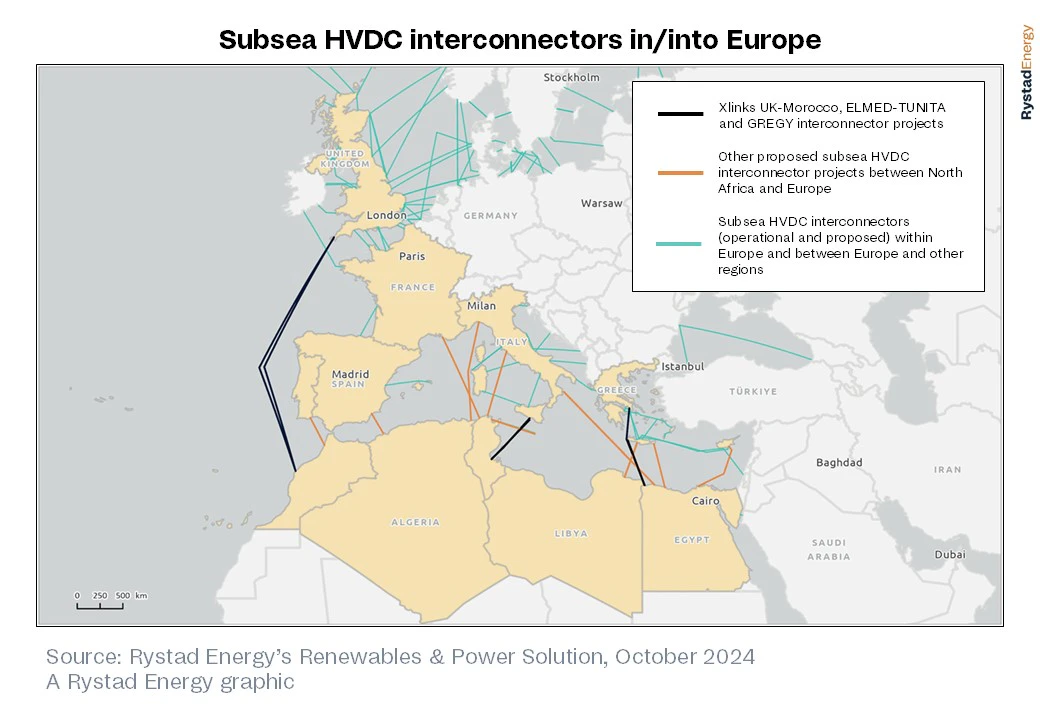
As highlighted by Rystad Energy, Morocco is currently the only African country directly connected to Europe. It is linked to Spain through two high-voltage cables, each with a capacity of 700 megawatts. A third cable of the same capacity is also planned as part of the Xlinks UK-Morocco project. This initiative aims to deliver 11.5 GW of intermittent renewable capacity, 22.5 gigawatt hours of battery energy storage, and a 3.6 GW submarine interconnection between the United Kingdom and Morocco.
Other interconnections are also under development. These include the GREGY initiative between Greece and Egypt, and the ELMED-TUNITA project linking Tunisia and Italy, both of which have attracted significant investment from governments and financial institutions.
Europe looks to North Africa to cut dependence on Russian gas
“The renewable energy potential of North Africa aligns with Europe’s objective to reduce its reliance on Russian natural gas. The region’s geographical proximity makes it a natural choice, leading to large-scale solar and wind projects, alongside submarine cables across the Mediterranean,” said Nivedh Das Thaikoottathil, senior analyst at Rystad Energy. “Wind power in Europe peaks in winter, while solar power peaks in summer, creating an opportunity to balance fluctuations in energy supply. This helps diversify energy sources and reduce the use of fossil fuels in Europe’s power sector.”
Three interconnections could supply 1.6% of Europe’s total electricity
According to Rystad Energy’s analysis, if all the electricity generated by these and other African renewable facilities were delivered to Europe, three interconnections operating at full capacity could supply around 55 TWh per year. This would represent about 1.6% of Europe’s current total electricity generation and could potentially replace around 6% of fossil fuel-based power generation in Europe.
North Africa is emerging as a key player in the Mediterranean energy transition. With annual power production exceeding 400 TWh, it is the African region with the highest electricity access rates. It therefore plays a crucial role in advancing onshore wind and solar photovoltaic deployment, with more than 350 GW of projects currently at various stages of development.
The region also hosts some of the world’s largest solar installations. These include Egypt’s Benban Solar Park, the largest solar project in Africa, made up of 41 separate photovoltaic plants spread across 37 square kilometres. Until last year, Morocco was home to the world’s largest concentrated solar thermodinamic power plant, the 510 MW Noor Ouarzazate complex. Africa’s largest wind projects are also located in Egypt, including the 580 MW Gabal El Zeit wind farm and the 545 MW Zaafarana project.
North Africa’s strong solar resources support the energy transition
Thanks to favourable solar irradiation conditions, solar plants in North Africa can generate up to three times more output than those in Europe. According to the consultancy, daily photovoltaic output in the region ranges from 4.8 to 5.6 KWh per KWp, compared with 3.6 to 4.8 KWh per KWp in Europe. This advantage is complemented by strong wind resources, with average wind speeds between 7 and 10 metres per second, higher than those typically found in southern Europe.
However, North African countries face constraints in their supply chains when it comes to meeting rising demand for solar and wind energy. These limitations are largely linked to dependence on imports from third countries.
Supply chain risks, including submarine cables
Similar challenges are expected in the availability of high-voltage direct current and extra-high voltage submarine cables. From 2023 onwards, Europe has produced more than 50% of these cables, with around 9,000 kilometres currently in operation worldwide. New manufacturing plants are expected to increase this supply to around 16,000 kilometres by 2030.
According to Rystad Energy’s analysis, demand is expected to exceed 75,000 kilometres by 2030. This could create a significant gap between supply and demand, potentially requiring intervention from Asian manufacturers and pushing European companies to urgently scale up their production capacity.