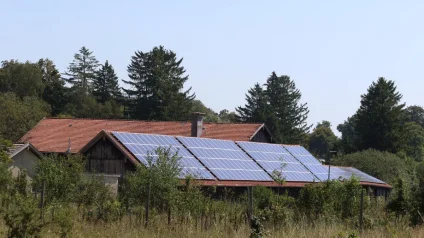
Africa has imported a record 15 GW of solar panels from China in just 12 months. If installed, this capacity could reshape electricity systems across the continent.

Solar panels in Africa reach unprecedented import levels
Over the past twelve months, Africa has experienced an unprecedented acceleration in solar panel imports from China.
According to a new report by Ember, an independent think tank specialising in global energy data analysis, the continent imported 15,032 MW of solar panels between June 2024 and June 2025. This represents a 60 percent increase compared to the 9,379 MW imported in the previous year.
If these volumes are translated into actual installations, they could significantly reshape electricity generation in many African countries. The analysis shows that the trend is no longer concentrated in South Africa alone. In just two years, imports outside Pretoria have tripled, rising from 3,734 MW to 11,248 MW.
Twenty countries set new all-time highs
The report highlights how growth has spread across a growing number of countries. Twenty African states reached new record levels of solar panel imports, while 25 countries exceeded the 100 MW threshold, up from 15 in 2023.
South Africa remains the continent’s largest buyer, but rankings have shifted. Nigeria has overtaken Egypt to become the second largest importer with 1,721 MW, followed by Algeria at 1,199 MW. Growth rates are striking: Algeria increased imports by 33 times, Zambia by 800 percent, Botswana by 700 percent and Sudan by 600 percent. Liberia, the Democratic Republic of the Congo, Benin, Angola and Ethiopia more than tripled their imports.
This diversification reflects a broader trend across sub-Saharan Africa, where countries are increasingly turning to solar to address power shortages and rising fuel costs.
New capacity with the potential to transform national power systems
The scale of these imports has major implications for national energy mixes. In Sierra Leone, if the solar panels imported in the past year were fully installed, they could generate electricity equivalent to 61 percent of the country’s total power production in 2023. In Chad, the share would reach 49 percent.
Liberia, Somalia, Eritrea, Togo and Benin would each see increases of more than 10 percent. Overall, 16 African countries could boost electricity generation by at least 5 percent.
These figures are particularly significant in a continent where around 600 million people still lack access to electricity and where demand is expected to grow rapidly in the coming years, including in fast-growing economies such as Senegal and Ethiopia.
Diesel too expensive, solar pays back in months
One of the most immediate impacts is the displacement of fossil fuel imports. In nine of the ten largest solar importers, the value of refined oil imports exceeds that of solar panels by a factor ranging from 30 to 107.
In Nigeria, for example, a 420-watt solar module costing 60 dollars can generate around 550 kWh per year, while spending the same amount on diesel produces only 275 kWh. The payback period for the solar investment is estimated at six months, and even shorter in countries where diesel prices are higher.
This makes solar power not only an environmental solution but also a powerful economic lever, freeing up resources that can be redirected towards development, infrastructure and social services.
A boom that requires constant monitoring
Ember describes the surge in solar panel imports as “a critical moment” for Africa, while warning that Chinese customs data only tell part of the story.
Panels arriving at ports are not always installed immediately. In some cases they are stored or re-exported, and accurate tracking systems are often lacking. This creates the risk of missed opportunities for effective energy planning.
For this reason, Ember calls for stronger research and monitoring. Greater transparency, the report argues, can help make Africa’s energy transition more inclusive, efficient and better coordinated.