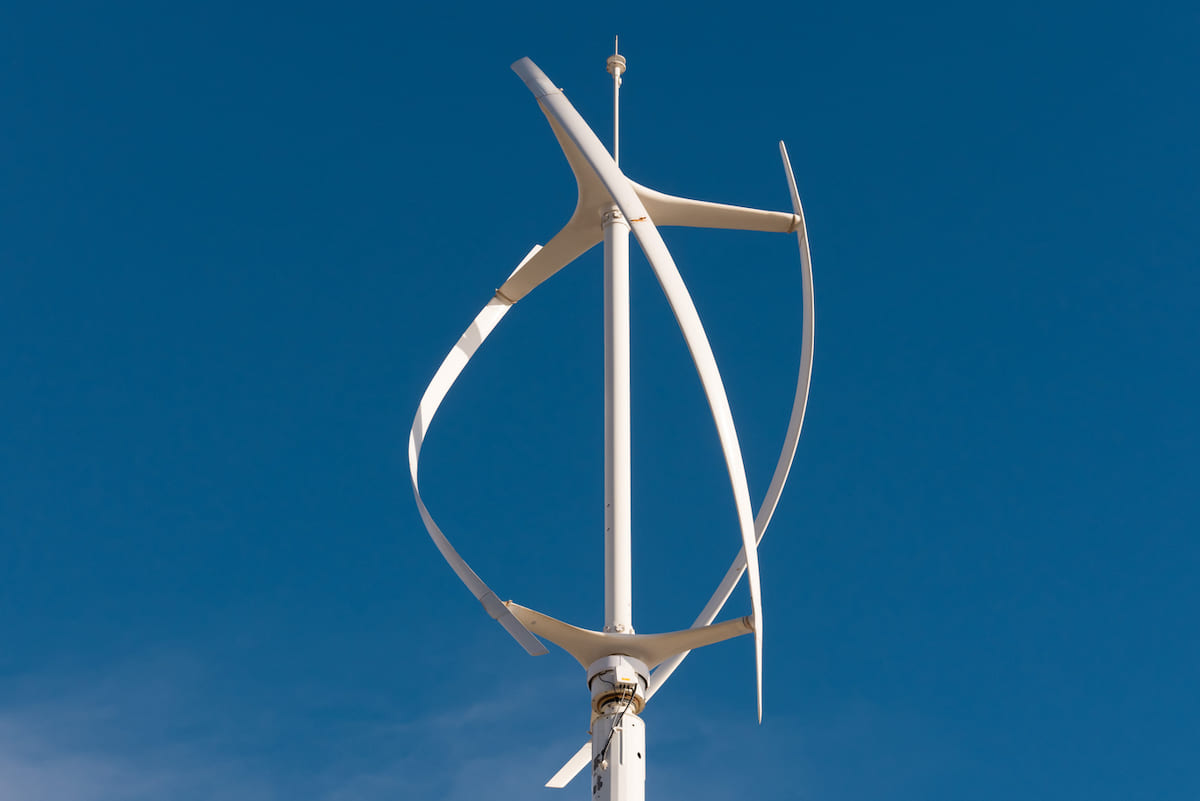
4D-printed wind turbine blades offer a new approach to eco-design
Reducing manufacturing time and costs while delivering reliable, high-performance wind turbine components. That is the goal behind a new manufacturing technique developed by engineers Emad Fakhimi and Suong Van Hoa at Concordia University in Canada, who have designed a method to produce 4D-printed wind turbine blades for vertical axis wind turbines.
The researchers demonstrated that composite blades can achieve a shape comparable to commercially available aluminium blades while being significantly lighter and faster to manufacture. The innovation could open new opportunities for the vertical wind energy sector, including projects in emerging renewable energy markets across Africa.
Vertical axis wind turbines rely on curved blades that are typically manufactured using specialised forming processes requiring complex moulds. These production steps increase both manufacturing costs and lead times. The new 4D printing approach could provide a more efficient alternative.
How does 4D printing work?
One of the latest advances in engineering design is 4D printing, a technology that creates objects capable of changing their shape or structural properties over time.
The term, however, covers two distinct manufacturing approaches. The first is conventional 4D printing, which uses soft, smart polymers such as hydrogels or shape-memory materials. These materials respond to environmental triggers including humidity, heat or pH by expanding, bending or changing shape.
The technique developed at Concordia University instead relies on 4D Printing of Composites (4DPC), a substantially different process that also requires moulds.
Rather than using smart polymers, 4DPC employs continuous carbon fibre composites impregnated with epoxy resin or embedded in thermoplastic matrices.
“These fibres are continuous and their volume fraction is relatively high, generally between 50% and 60%. As a result, the materials used in 4DPC exhibit higher stiffness, around 100 GPa, and greater strength, approximately 100 MPa,” the researchers write.
If the material is so rigid, how can it change shape?
The answer lies not in external environmental stimuli but in the orientation of the carbon fibres. Carbon fibre is anisotropic, meaning its mechanical properties vary depending on the direction in which the fibres are aligned.
Manufacturing 4D-printed wind turbine blades
To create the curved blades required for vertical axis wind turbines, the engineers deposited continuous resin-impregnated carbon fibres onto a flat surface, arranging successive layers in different orientations. The composite laminate was then heated to the resin’s curing temperature before being cooled.
During cooling, the different thermal behaviour of the materials produced the desired curvature. Carbon fibre has an almost zero coefficient of thermal expansion, while the resin contracts as it cools. Because each layer contains fibres aligned in different directions, the flat laminate naturally deforms into a curved shape.
The most innovative aspect of the research, however, is the design methodology. Instead of selecting fibre orientations first and observing the resulting geometry, the researchers started with the desired blade shape and worked backwards to determine the optimal fibre layout.
“This procedure saves time and costs because moulds with complex curvatures are no longer required,” write Fakhimi and Van Hoa. “At the same time, the resulting material is strong, stiff and lightweight, providing significant advantages in terms of weight and handling.”
Results show lighter blades with comparable performance
The 4D-printed wind turbine blades closely matched the geometry of commercial aluminium blades while weighing 80% less. Their lower weight also enabled faster rotation during laboratory testing.
The researchers caution, however, that several engineering challenges still need to be addressed before commercial deployment. These include bending stiffness, long-term durability under environmental exposure, fatigue resistance and structural safety under centrifugal and aerodynamic loads.
According to the authors, these aspects must be resolved to ensure safe and economically viable operation.
The study, Development of Vertical Wind Turbine Blades Using 4D Printing of Composites, by Emad Fakhimi and colleagues, was published in Polymer Composites (2026). DOI: 10.1002/pc.70998.