
Renewable electricity generation reaches a new global milestone
Renewable electricity generation continued its record-breaking expansion in 2024, confirming the accelerating role of clean energy in the global power mix. According to the latest Renewable Energy Statistics 2026 published by the International Renewable Energy Agency (IRENA), renewables accounted for 31.7% of global electricity generation in 2024.
The report compiles renewable energy data covering the past decade, from 2016 to 2025, highlighting the rapid transformation of electricity systems worldwide, including across emerging markets in Africa where renewable deployment continues to expand.
Renewable electricity generation: 2024 compared with 2023
IRENA’s latest statistics show that renewable electricity generation increased by 9.8% in 2024, a significantly faster pace than the previous year. Globally, renewable sources produced 9,836 terawatt-hours (TWh) of electricity, representing 31.7% of total electricity generation.
In 2023, renewable electricity generation had grown by 8.4% compared with 2022, reaching 9,152 TWh, up from 8,440 TWh. The renewable share of global electricity generation rose from 29.1% in 2022 to 30.3% in 2023.
By contrast, non-renewable electricity generation increased by only 1.4% in 2024, continuing its slower growth trajectory.
Renewable capacity reached a record level in 2025
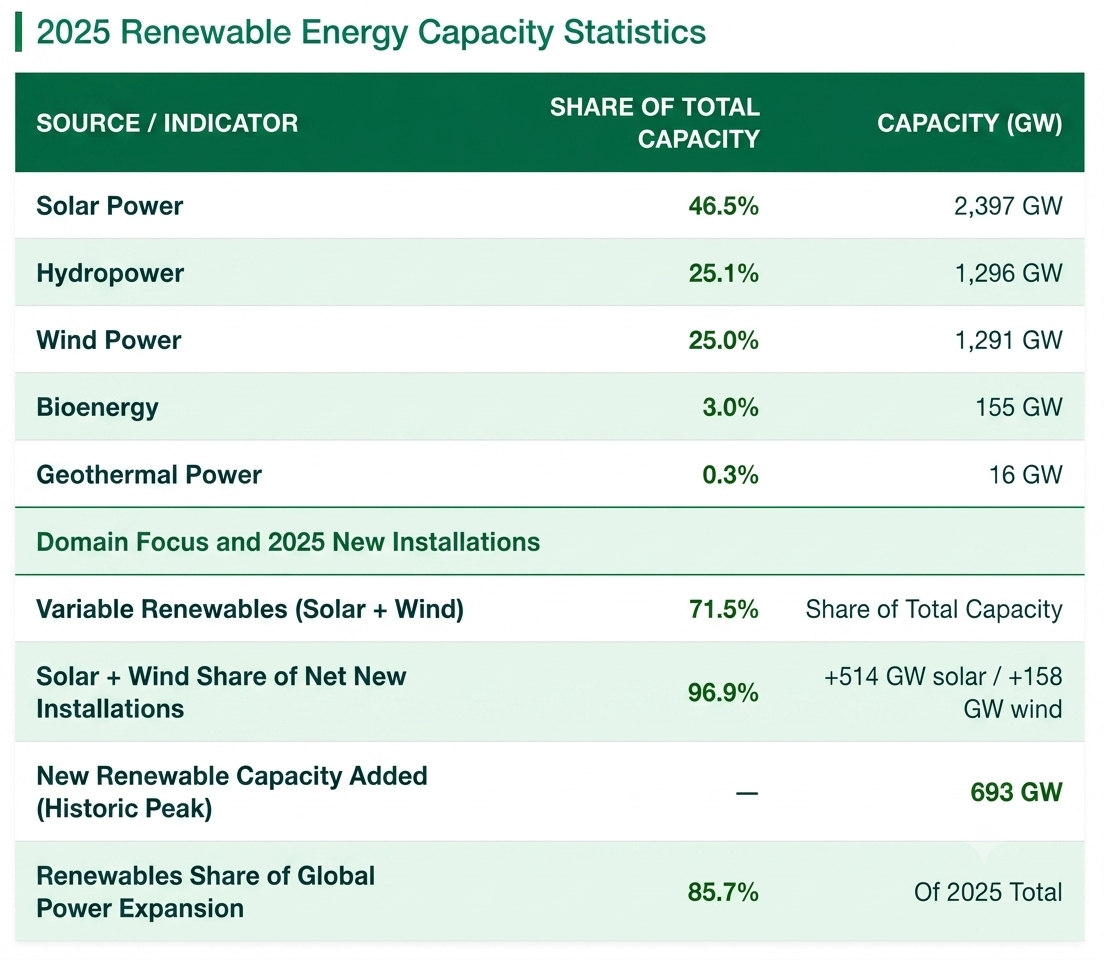
According to the same IRENA report, annual renewable capacity additions have increased dramatically over the past 25 years, reaching a record 693 GW in 2025.
By the end of 2025, global renewable power capacity stood at 5,155 GW, or approximately 5.2 TW, representing 49.5% of total installed global electricity capacity, which reached 10.4 TW including non-renewable sources.
Renewable capacity expanded by 15.1% in 2025 compared with 2024, well above the average annual growth rate of 11.9% recorded during the previous five-year period (2019-2024).
Renewables accounted for 85.7% of total new power capacity added in 2025, down from 92.7% in 2024. Despite the lower share of total additions, installed renewable capacity continued to grow much faster than non-renewable technologies.
Regional renewable electricity generation in 2024
The latest data confirm that solar and wind power remained the main drivers of renewable electricity generation worldwide.
Asia maintained its leading position, generating 4,589 TWh of renewable electricity in 2024, an increase of 14.3% across all renewable technologies. The region recorded particularly strong growth in both solar and wind energy.
Europe generated 1,758 TWh, up 7.2%, driven mainly by higher solar and hydropower output.
North America produced 1,535 TWh, representing a 5.8% increase, while South America generated 1,047 TWh, up 2.9%.
The Middle East produced 76 TWh, recording the fastest regional growth rate at 17.3%.
Central America and the Caribbean generated 55 TWh, an increase of 5.8%.

The challenge for 2035
To meet the global commitment agreed at COP28, which aims to triple installed renewable capacity to more than 11 TW by 2030, specifically 11.17 TW, IRENA estimates that the world still needs to install approximately 6.02 TW of additional renewable capacity.
Building on IRENA’s roadmap, the Turkish Presidency of COP31 has announced a global target to increase electrification to 35% of final energy demand by 2035.
The newly released electricity generation data show that achieving this objective would require increasing the share of renewable electricity generation from 31.7% in 2024 to 78% by 2035. Reaching that milestone would require global deployment to accelerate by approximately 2.5 times compared with the current growth rate, an objective that will be relevant across both advanced economies and rapidly growing energy markets, including Sub-Saharan Africa.