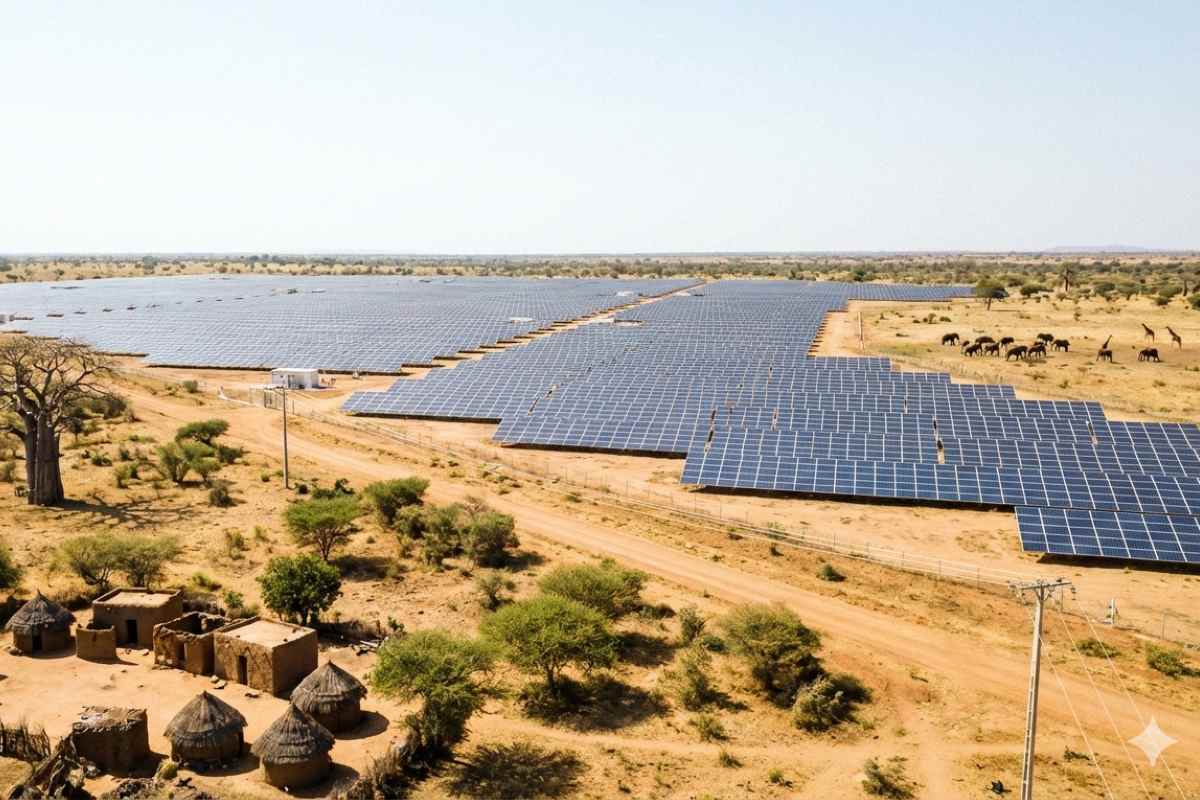
A record year for solar photovoltaic in Africa
Solar photovoltaic in Africa recorded its fastest growth ever in 2025, with around 4.5 GW of new capacity installed, a 54% increase compared to the previous year. This marks a new all-time high and positions the continent among the world’s fastest-growing solar markets.
The data comes from the Africa Market Outlook for Solar PV: 2026-2029, published by the Global Solar Council in collaboration with African solar associations and international partners.
The expansion surpassed the previous record set in 2023 and outpaced medium-term projections made just one year earlier.
The picture that emerges is of a market in strong acceleration, increasingly less concentrated in a handful of countries and more driven by distributed systems, commercial installations and self-consumption solutions. This trend reflects rising electricity demand, persistent grid constraints and the continued decline in solar technology costs across Africa, including Sub-Saharan regions.
Which countries drove solar photovoltaic in Africa in 2025
In 2025, the ten largest markets accounted for around 90% of new installations, confirming the leadership of more mature countries. South Africa ranked first with 1.6 GW, followed by Nigeria with 803 MW, Egypt with 500 MW and Algeria with 400 MW.
Alongside these established leaders, the report highlights the growing contribution of mid-sized markets. Morocco installed 204 MW, Zambia 139 MW, Tunisia and Botswana 120 MW each, Ghana 92 MW and Chad 86 MW. These increases supported a broader geographic diversification of solar photovoltaic in Africa.
A key indicator is the doubling of the number of countries surpassing 100 MW of annual installations, from four to eight in just one year. This trend strengthens the resilience of the African solar market and reduces reliance on a limited number of large utility-scale projects.
The growing role of distributed and commercial systems
One of the central findings of the report concerns the changing structure of the market. In 2025, 56% of installed capacity came from utility-scale plants, while 44% was attributed to distributed, commercial and rooftop systems.
According to the Global Solar Council, this share is likely underestimated, as many installations are not fully captured by official statistics.
Import data reinforces this interpretation. Africa imported 18.2 GW of solar modules in 2025 alone, a volume that significantly exceeds projected utility-scale installations for 2026-2027, estimated at 14.3 GW in total under the medium scenario.
The gap between imports and large-scale projects suggests that a substantial portion of solar photovoltaic in Africa consists of distributed systems, often privately financed and aimed at households, businesses and productive activities. This dynamic is particularly relevant in contexts where grid reliability remains a challenge, including parts of West Africa and Eastern Africa.
Solar photovoltaic in Africa still relies heavily on public finance
The report describes the evolution of the African solar market as the outcome of two parallel energy transitions. On one side, a government-led transition based on large, grid-connected plants supported mainly by public and multilateral finance.
On the other, a private transition driven by rooftop, commercial and captive systems responding to the need for reliable and continuous power supply. The challenge, the Global Solar Council notes, is that financing models have not yet adapted.
Around 82% of clean energy financing in Africa still comes from public and development sources. Distributed solar, however, requires different instruments, smaller ticket sizes, shorter tenors and financing in local currencies.
Although private investment increased from 17 billion dollars in 2019 to nearly 40 billion dollars in 2024, access to capital remains difficult for many small-scale initiatives.
Future growth depends on rising electricity demand
According to the report, the next phase of solar photovoltaic in Africa will be less about nominal capacity targets and more about the readiness of power systems.
Electricity demand is expected to rise rapidly and could increase eightfold by 2050 compared to current levels. In this context, solar will need to be increasingly integrated with energy storage, more flexible grids and balancing solutions.
The document stresses that solar and storage together represent a critical combination to ensure reliability, climate resilience and energy security.
Without upgrades to infrastructure and regulatory frameworks, there is a risk that installation rates could slow and system costs rise, despite the continent’s abundant solar resource, which accounts for around 60% of the world’s best potential.
Solar photovoltaic in Africa: outlook to 2029 between opportunities and risks
The medium-term scenario outlined by the Global Solar Council points to an average annual growth rate of 21% through 2029, with more than 33 GW of new capacity installed by the end of the decade. This would represent a volume more than six times higher than that added in 2025 alone.
Achieving this trajectory will depend on better alignment between real market dynamics and public policies. The report identifies several priorities: lowering the cost of capital, simplifying permitting procedures for distributed solar, developing national storage strategies, improving transparency in grid planning and strengthening data collection.
Without these reforms, the acceleration seen in 2025 risks falling short of delivering long-term, structural growth for solar photovoltaic in Africa.