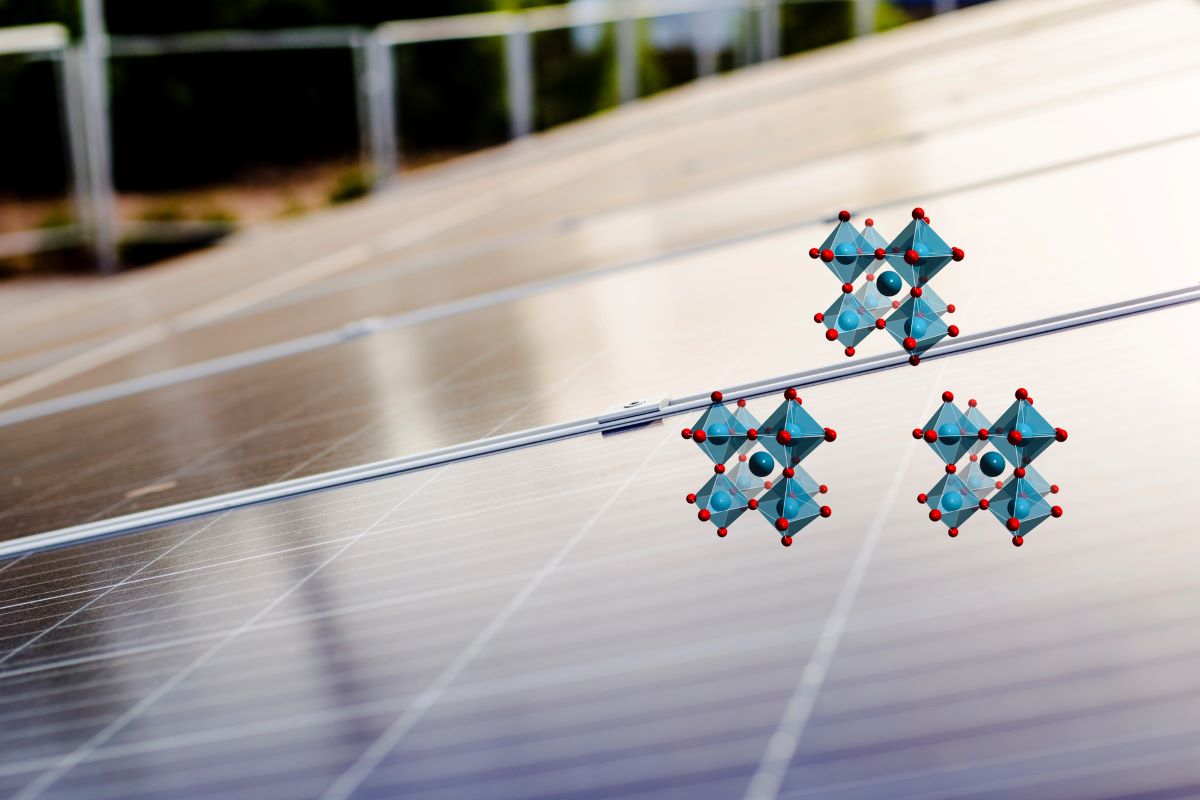
Perovskite tandem solar cells move beyond silicon limitations
For years, researchers have been experimenting with perovskite in multijunction photovoltaic devices. Combined with silicon, the material has already delivered performances far beyond the capabilities of single-junction solar cells and the so-called Shockley-Queisser limit.
The current segment record belongs to LONGi, which achieved a 35% efficiency with an 84.3% fill factor using a 1.0028 cm² perovskite/silicon tandem cell.
One of the major advantages of synthetic perovskites is their tunability across different wavelengths. When paired with silicon, they can absorb high-energy photons that silicon alone cannot efficiently capture, allowing a much broader portion of sunlight to be converted into electricity.
This raises a key question for the solar industry: why not remove silicon altogether and develop fully perovskite tandem solar cells, avoiding the material’s structural limitations and high energy-intensive manufacturing process?
The crystallization challenge in all-perovskite tandem solar cells
Despite their potential, perovskites also present significant technical challenges. One of the main barriers for all-perovskite tandem solar cells is asynchronous crystallization within perovskite films.
Different sections of the material crystallize at different times, generating compositional and structural inhomogeneities that ultimately reduce both efficiency and long-term device stability.
Chemical hardness engineering synchronizes crystal growth
Researchers at the Ningbo Institute of Materials Technology and Engineering (NIMTE) may now have identified a solution.
The team, led by Professor Ge Ziyi and Professor Liu Chang, developed a chemical hardness-based strategy to control perovskite crystal growth. Specifically, the researchers designed additive engineering based on Hard and Soft Acids and Bases (HSAB) theory.
They identified difluoro(oxalato)borate (DFOB⁻) as an effective additive for wide-bandgap perovskites and tetrafluoroborate (BF₄⁻) for narrow-bandgap perovskites.
These compounds selectively coordinate with precursor species, synchronizing nucleation and crystal growth while improving film uniformity.
Perovskite tandem solar cells achieve certified 30.3% efficiency
The results mark an important milestone for next-generation photovoltaics.
The monolithic two-terminal all-perovskite tandem solar cells achieved a certified efficiency of 30.3%, alongside an improved open-circuit voltage of 2.16 V and an 85.2% fill factor.
The devices also maintained 92% of their initial efficiency after 1,000 hours of maximum power point tracking, highlighting significant progress on operational stability.
Flexible tandem versions reached a certified efficiency of 28.2%, with stabilized performance at 28.0%.
The full research paper, “Chemical hardness engineering synchronizes crystallization in perovskite tandems”, was published in the journal Nature Nanotechnology.