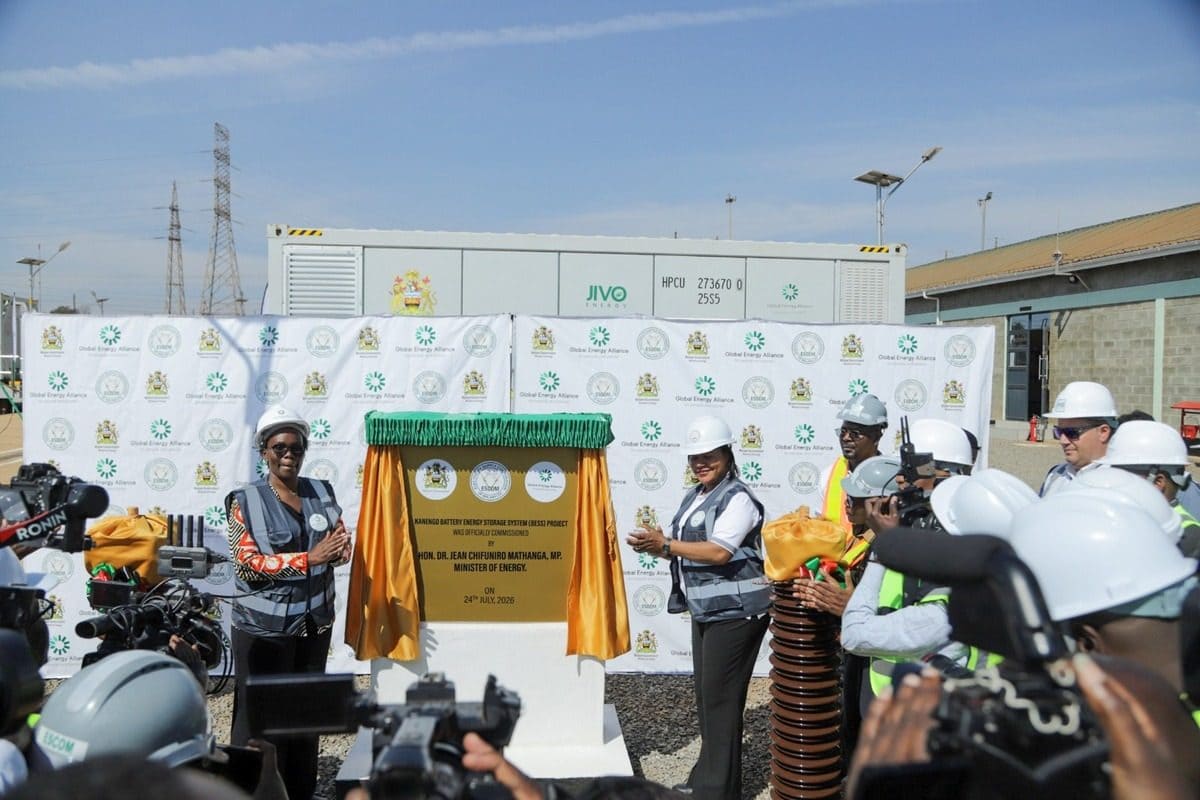
A landmark battery storage project for southern Africa
Malawi has commissioned the only utility-scale battery energy storage system (BESS) in Southern Africa outside South Africa and Namibia. The project features 20 MW of power capacity and 40 MWh of energy storage, helping stabilize the country’s electricity supply while strengthening resilience to climate change.
A model for battery storage across Africa
The project is the result of a partnership between the Global Energy Alliance for People and Planet (GEAPP), the national utility ESCOM, and the Government of Malawi. Its main objective is to improve electricity reliability for households, businesses and essential public services while making the power system more resilient to climate-related disruptions.
Beyond its national role, the facility is designed to serve as a regional learning hub for battery storage deployment across Sub-Saharan Africa. It will collect, analyse and share operational data to support the development of future large-scale BESS projects throughout the region.
Located in Kanengo, north of the capital Lilongwe, the system stores electricity when generation is high and releases it during periods of peak demand or lower renewable output.
The project is expected to unlock 100 MW of existing renewable generation capacity while improving grid stability. Solar power currently contributes around 100 MW to Malawi’s total installed generation capacity of approximately 580 MW.
“Malawi’s battery energy storage system will deliver reliable electricity to hospitals, schools, businesses and homes without the outages, noise, pollution and costs associated with diesel generators. It means cleaner air, lower emissions and sets a new benchmark for energy infrastructure across Africa,” said Carol Koech, Vice President for Africa at the Global Energy Alliance for People and Planet.
Malawi’s electricity network continues to face significant challenges, including grid instability, the curtailment of renewable generation to prevent network overload, and an expensive dependence on diesel-powered backup generation.
Supporting climate resilience and energy access
The project is expected to provide more reliable electricity access for 2.45 million people while reducing carbon emissions by around 10,000 tonnes per year.
It also supports Mission 300, the joint initiative by the World Bank Group and the African Development Bank that aims to connect 300 million people across Africa to electricity by 2030.
Officials from the Electricity Supply Corporation of Malawi (ESCOM) activated the system over the weekend as the country faces another climate-related challenge. A strong El Niño event is bringing higher temperatures that are expected to reduce water flows in the Shire River, the source of most of Malawi’s hydropower generation.
The country’s vulnerability was already exposed in 2022, when a cyclone destroyed around one-third of Malawi’s hydropower capacity, highlighting the need for a more resilient and diversified electricity system.
Malawi also has one of the world’s lowest electrification rates. Only about 25% of the population currently has access to electricity, while the government aims to increase that figure to 70% by 2030.