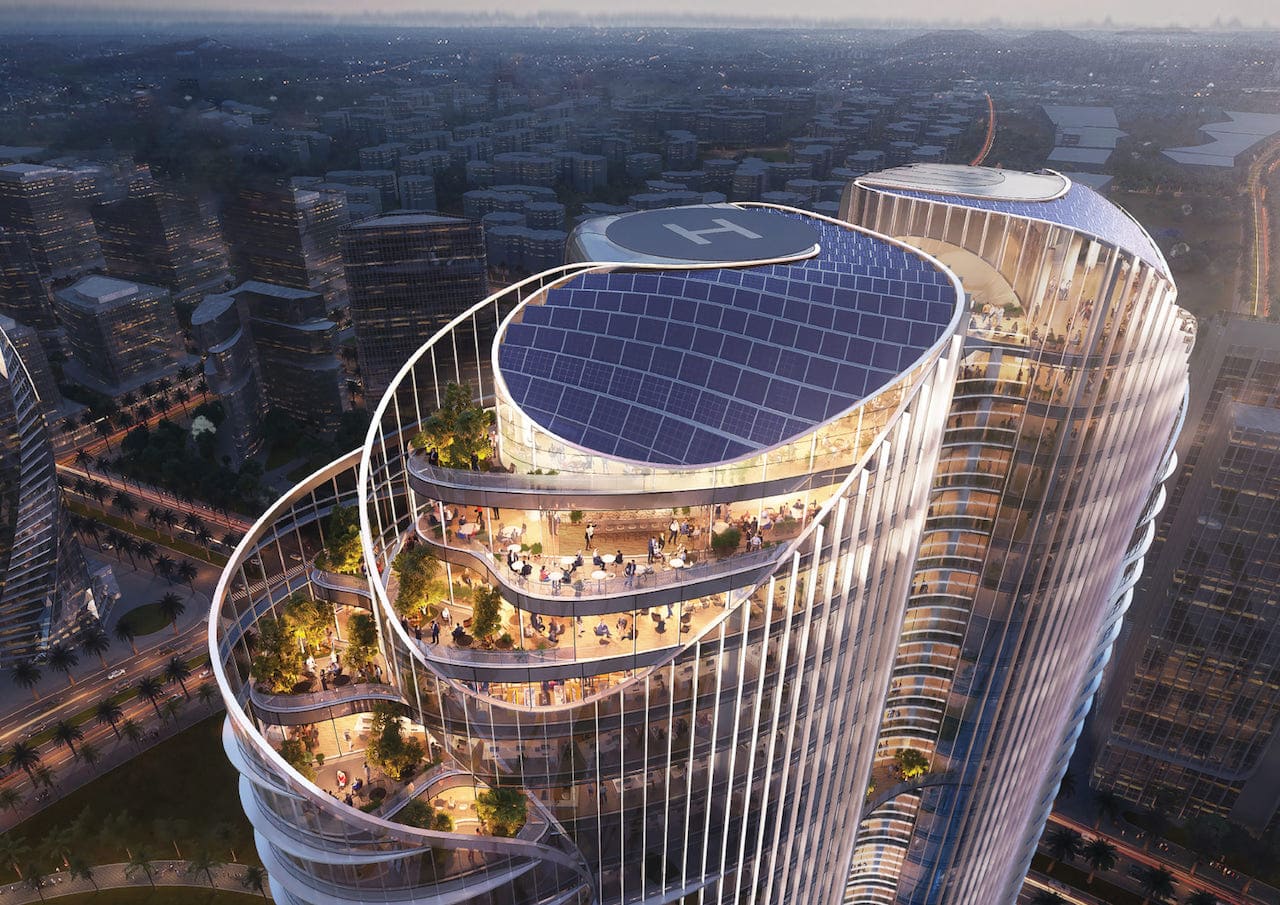
Forbes International Tower: a beacon of green architecture
Thirty miles east of Cairo, Egypt, a new city, dubbed the “New Administrative Capital” of the country, is slowly emerging. While debates persist regarding the strategic utility of this new administrative hub for the nation, a discourse common across rapidly urbanising African cities, the construction of the Forbes International Tower, hailed by its proponents as “the greenest skyscraper ever built,” undeniably captures significant attention. This 240-metre tower will be powered by renewable energy and hydrogen, aiming to halve consumption and waste from its earliest design stages.
Designed by Adrian Smith + Gordon Gill Architecture and developed by Magnom Properties, the Forbes International Tower aims to ensure a net-zero carbon footprint. To achieve this, it will be powered partly by clean hydrogen and partly by solar energy produced by photovoltaic panels placed on the façade. Magnom Properties has signed an agreement with Schneider Electric and H2 Enterprises to evaluate the use of liquid organic hydrogen carrier (LOHC) technology as an energy source for the skyscraper.
Energy independence and net-zero design strategy
According to its developers, Egypt’s green skyscraper will not depend on the electrical grid, aiming for complete energy independence. This ambitious pursuit, echoing similar drives for energy resilience in nations like South Africa and Senegal, offers a compelling model for sustainable urbanisation efforts across the continent, where energy security remains a critical concern.
The objective is to achieve both LEED Platinum and Zero Carbon certifications from the International Living Future Institute, targets that are extremely complex for so-called “super tall” buildings to reach. The project will utilise low embodied carbon materials to become an eco-sustainable model in skyscraper construction. Situated in the Central Business District of the New Administrative Capital, the tower seeks to elevate ecological design standards. Given its geographical location, the available energy and natural resources on site will allow for the strengthening of energy performance standards. In addition to active production, the energy demand of the Forbes International Tower will also be reduced through a high-performance envelope with enhanced insulation and a series of state-of-the-art, fully automated HVAC systems.
Biophilia, water recycling and artificial intelligence
While biophilic designs will aid air circulation, bringing nature indoors to enhance employee well-being, a water resource reduction and recovery system will conserve water, a precious element in this desert context. Furthermore, a rainwater harvesting tank will provide water for non-potable uses. Alongside the physical well-being of occupants, also fostered by indoor nature, the green skyscraper will feature a management system controlled by Artificial Intelligence. IoT sensors, machine learning, and cutting-edge systems complete the innovation cycle, while discussions are already underway about exclusive electric mobility connections and drone fleets.