A new approach to turning emissions into energy
One of the most pressing challenges in the energy transition is combining clean power generation with the reduction of climate-altering emissions. The so-called greenhouse gas battery moves in that direction, offering a system that can both clean the air and generate electricity.
Developed by a group of universities and research institutes in South Korea, the Gas Capture and Electricity Generator is not a conventional battery, at least not in the strict technical sense.
It belongs to a class of systems that is still not fully standardized, capable of generating electricity through ion gradients driven by gas interactions. This approach has nothing to do with CO2-based batteries such as those developed by Energy Dome.
Carbon capture, towards energy self-sufficiency
The starting point of the South Korean research was to optimize carbon capture, utilization and storage (CCUS) technologies. Today, these systems still occupy a niche due to the difficulty of scaling them economically.
The main bottleneck is what is known as the energy penalty. Absorbing and processing gases requires large amounts of energy, significantly increasing operational costs. In some cases, the efficiency of a thermoelectric plant integrated with carbon capture can drop by up to 50% to sustain the process.
To overcome this limitation, the research team introduced a fundamentally new mechanism that directly converts the physico-chemical energy generated during gas adsorption on electrode surfaces into electricity.
This issue is also relevant for fast-growing energy systems, including in parts of Sub-Saharan Africa, where balancing energy access and emissions reduction remains a structural challenge.
How the Gas Capture and Electricity Generator works
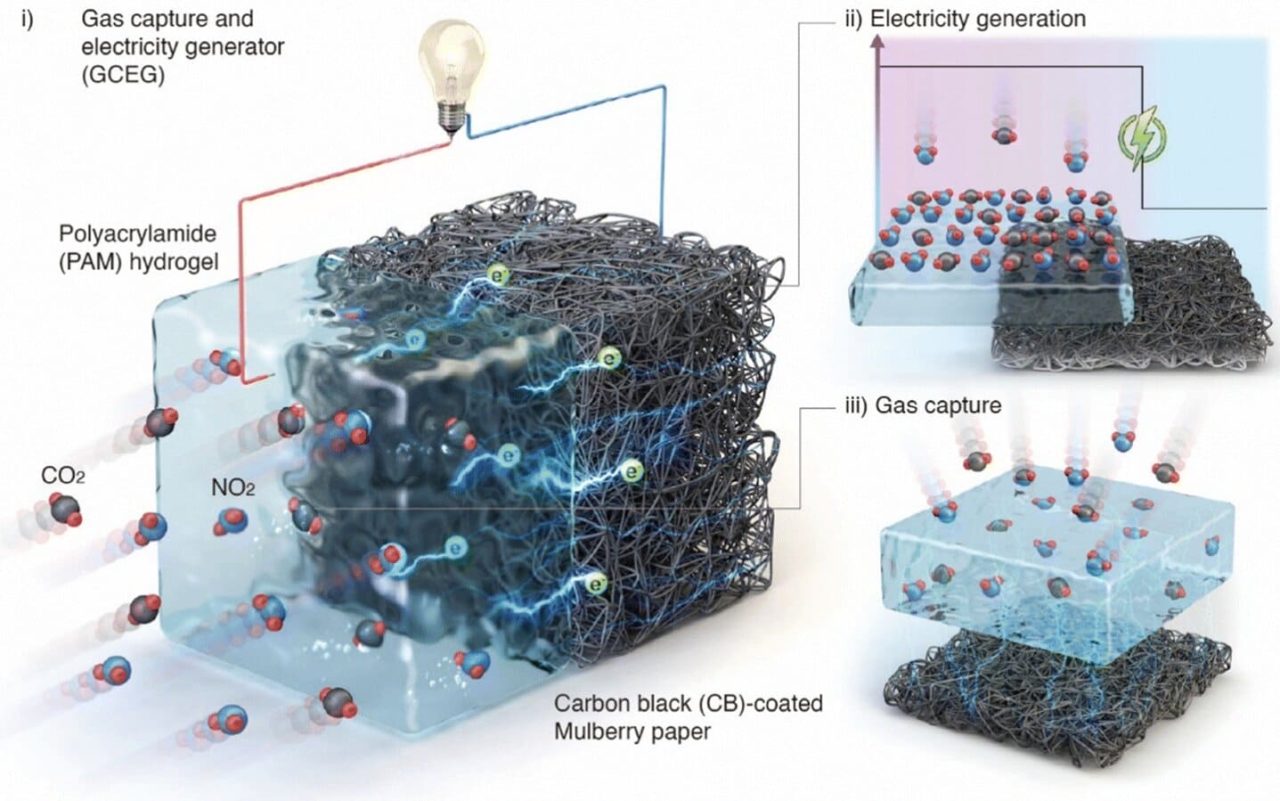
The strength of the Gas Capture and Electricity Generator lies in its structural simplicity. The system uses low-cost and sustainable materials:
- a mulberry paper electrode, offering a natural porous structure
- a carbon black coating, making the paper electrode conductive
- a polyacrylamide hydrogel (PAM) applied asymmetrically, enabling selective adsorption of NOx and CO2
This asymmetry is crucial because it creates a physico-chemical gradient that allows current to flow in a specific direction. When greenhouse gases are adsorbed, a sequence of charge redistribution and ion migration occurs within the device, generating a potential difference and an electric current.
In essence, as explained by Sungkyunkwan University, the pollutant molecules act as a kind of “fuel” for electricity generation, purifying the air while producing energy.
The performance of the greenhouse gas battery
The results are still modest but promising. In the presence of 50 ppm of NO2, the greenhouse gas battery shows an open-circuit voltage (VOC) of about 0.8 V and a short-circuit current of around 80 µA, supported by the reversible dynamics of gas adsorption and desorption.
The output voltage remains stable for up to 24 hours under continuous gas flow, demonstrating good reproducibility.
“This research,” said Professor Ji-Soo Jang from the Department of Nanoengineering at Ajou University, “shows that greenhouse gases are not simply pollutants to manage, but can act as a new energy resource. Our goal is to further develop this technology into an environmental platform that not only achieves carbon neutrality, but also generates energy.”
The study Electrical power generation from asymmetric greenhouse gas capture was published in Energy & Environmental Science.