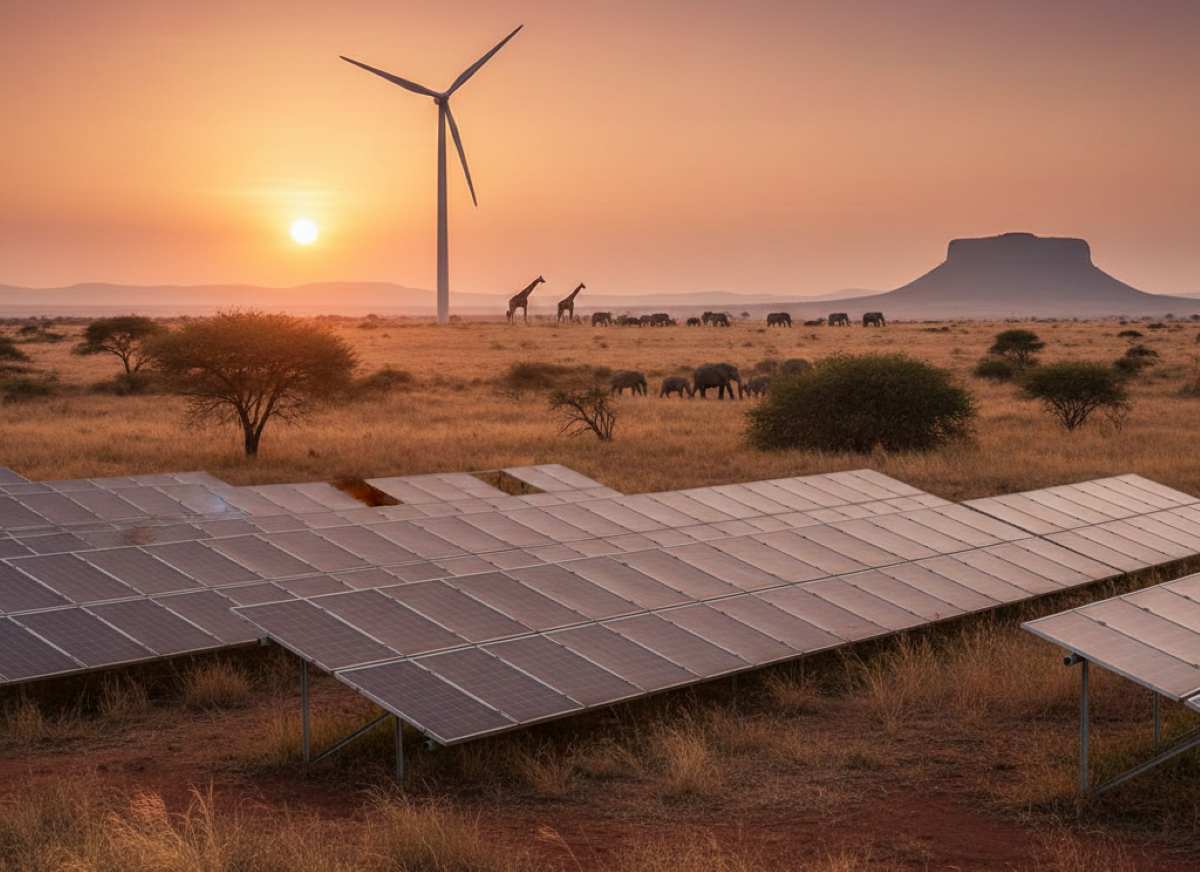
€15.5 billion to accelerate clean energy in Africa
The goal of expanding clean energy in Africa is at the heart of an international campaign that has mobilised €15.5 billion to scale up renewable generation and improve access to electricity across the continent. The commitments are expected to deliver an additional 26.8 GW of renewable capacity and provide a more stable electricity supply to 17.5 million households.
The European Union has contributed more than €15.1 billion, confirming its position as the main driver of investment. The programme covers 13 African countries and includes projects spanning power plants, electricity networks and cross-border interconnections, from hydropower generation to new solar developments. The aim is to narrow a gap that still leaves 600 million people without electricity and to unlock energy growth that remains well below the continent’s potential.
Europe’s role: €15.1 billion from Team Europe
European commitments include more than €10 billion announced under the Team Europe framework, alongside additional bilateral financing. Funds come from EU member states, public financial institutions and private investors, and are aligned with the Global Gateway Africa initiative, which supports sustainable growth and deeper energy integration across the continent.
Within this framework, financing includes €2.1 billion from the European Investment Bank and €740 million from the European Bank for Reconstruction and Development, together with commitments from individual European countries. The priorities are clear: scale up renewable investment in Africa, strengthen resilient electricity networks and support projects that expand access to power for households and businesses.
“Today the world has taken a step forward for Africa. With fifteen point five billion euros, we are accelerating the transition towards clean energy across the continent. Millions of people will gain access to electricity, a real change for families, businesses and entire communities. This investment opens new opportunities, growing markets, new jobs and clean, reliable energy. We look to a future led by Africa, with the strong support of Europe, a friend and partner,” said Ursula von der Leyen, president of the European Commission.
26.8 GW and 17.5 million households: the expected impact
The secured commitments are expected to deliver 26.8 GW of new renewable capacity and provide electricity to 17.5 million households that currently lack a stable supply. The figures highlight the scale of the challenge. Installed renewable capacity across Africa stands at 70.8 GW, well below the continent’s potential and insufficient to meet rapidly rising demand.
The “Scaling Up Renewables in Africa” campaign was launched to address this structural gap and support the energy transition in a continent where population growth and urbanisation are accelerating.
The initiative is also linked to Mission 300, promoted by the World Bank and the African Development Bank, which broadens the scope of intervention to include electricity generation, transmission, distribution and clean cooking solutions.
National projects across 13 African countries
The campaign supports a wide range of country-specific projects, each designed to respond to local needs and energy systems.
In Madagascar, construction is planned for the Volobe hydropower plant. Malawi will see the development of the Mpatamanga hydropower project, while Benin will focus on rehabilitating and expanding low and medium voltage electricity networks.
Zambia’s Newza 2.0 programme integrates solar energy and digital technologies into urban water systems. In Côte d’Ivoire, a new photovoltaic plant will be built in Sérébou.
In the Democratic Republic of the Congo, the ElectriFi initiative will support new renewable energy projects. Uganda will host two major interventions, covering the interconnection line with Tanzania and the rehabilitation of the Nalubaale–Kira hydropower plant.
Additional projects are planned in Burundi, Morocco, Tunisia and Egypt, as well as across multiple African regions through clean cooking programmes, Mediterranean interconnections and dedicated funds for resilient energy infrastructure.
Global Gateway Africa and the 2030 targets
These actions fall within the broader EU–Africa Investment Package, which allocates €150 billion by 2030. The plan aims to deliver at least 50 GW of new renewable capacity and expand electricity access to 100 million people across Africa.
Several flagship projects are already underway, including the Nachtigal hydropower plant in Cameroon, expected to increase national electricity capacity by 30 percent, and the rehabilitation of the Kariba dam between Zambia and Zimbabwe. A new interconnection linking Zambia, Tanzania and Kenya is also under development to strengthen regional electricity trade.
Overall, the strategy reflects a multi-level approach focused on modern infrastructure, regional integration and long-term investment, reinforcing clean energy in Africa as a pillar for sustainable growth and energy security.