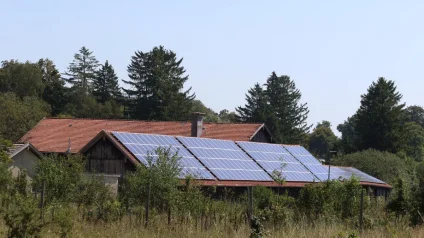
Fraunhofer ISE’s ShadeCut technology adds logos, roof-tile effects and decorative patterns to solar modules while keeping performance losses limited.

Beyond blue and black: customized photovoltaics enters a new phase
Coloured solar panels are no longer new. For several years, companies have offered red, green or brown modules as alternatives to traditional blue and black panels.
The goal is mostly aesthetic. Customized photovoltaics can help overcome local architectural and landscape constraints, or provide attractive urban design elements with a dual function.
The drawback? In almost all cases, the technology used to colour photovoltaic modules affects solar absorption and, as a result, efficiency and electricity output.
In today’s market for customized solar panels, performance varies significantly depending on whether the manufacturer uses coloured glass, coloured encapsulants, interference coatings or dye-sensitized solar cells, the well-known Grätzel cells.
MorphoColor® technology
One of the most efficient systems for adding colour to solar panels while maintaining high performance was developed in the laboratories of the Fraunhofer Institute for Solar Energy Systems ISE in Germany and commercialized under the MorphoColor® brand by Switzerland’s Megasol Energie.
The technology uses a natural principle found in the wings of Morpho butterflies, which appear blue thanks to three-dimensional photonic structures that reflect a specific range of wavelengths.
Fraunhofer ISE scientists managed to apply a similar surface structure to the back of the cover glass of their solar panels through a vacuum process. Depending on the fineness of the structure, different colours can be produced optically.
On performance, independent measurements show an output equal to 95% of the power of an uncoated module.
ShadeCut technology
The German institute has now taken the technology a step further, creating a new line of customized photovoltaics with logos and designs.
The desired design is engraved onto films coated with MorphoColor® using laser processes or CAD-controlled methods. This makes it possible, for example, to imitate roof tiles or create lettering and decorative patterns on the surface.
“Thanks to targeted structuring and cut-outs on a colour-producing film, we can integrate colour effects and complex patterns directly into solar modules and façade elements,” explains Marco Ernst, inventor of the ShadeCut technology and researcher at Fraunhofer ISE. “In addition, further layers with cut-outs can be added to create additional structures or colours.”
“This technology is particularly interesting for modules intended for integration into façades, photovoltaic roofs or even railings, especially on historic buildings,” adds Dr Martin Heinrich, head of the group for photovoltaic encapsulation and integration at Fraunhofer ISE. “Modules with ShadeCut can resemble masonry or roof tiles and blend in perfectly in terms of colour. It also allows photovoltaic systems to be customized, for example with logos or decorative patterns.”
In this case too, the panel loses only 5% efficiency. The new customized photovoltaics technology with ShadeCut will be unveiled at The Smarter E / Intersolar 2026 at the Fraunhofer ISE stand, A1.440.