Smart Cities in Africa between urban growth and digital transition
By 2050, more than 60% of Africa’s population will live in urban areas. This rapid expansion, if left unmanaged, could worsen poverty, emissions and inequality. But an alternative path is emerging, the rise of smart cities.
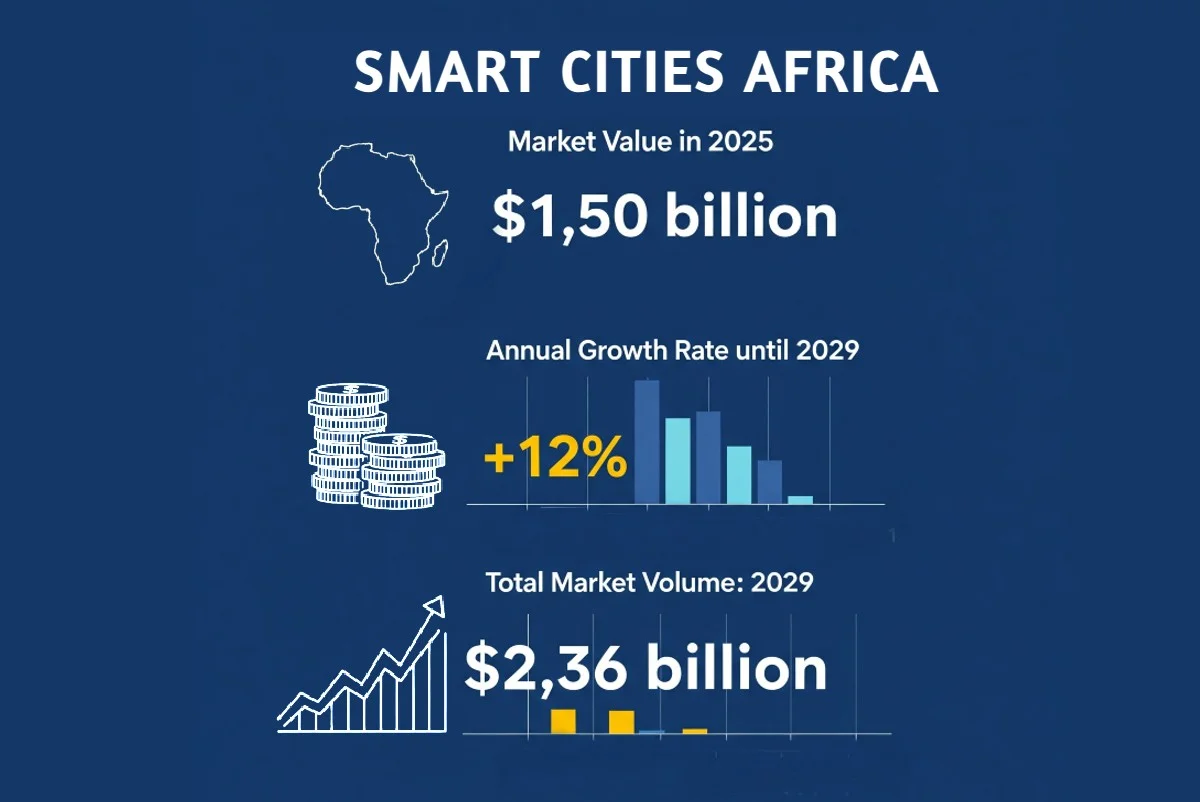
With a market expected to reach 1.5 billion dollars by 2025 and an annual growth rate of 12% through 2029, Smart Cities in Africa are positioning themselves as a global urban innovation laboratory. From Kigali to Nairobi, from Lagos to Tunis, smart solutions are gradually reshaping African cities by placing digital technologies, renewable energy and climate resilience at the centre of urban development.
Smart Cities in Africa market growth, +12% per year until 2029
According to the German business intelligence platform Statista, the Smart Cities in Africa market is expected to generate 1.50 billion dollars in revenue by the end of 2025.
With a steady estimated growth rate of 12% from now until 2029, the overall value of Africa’s smart cities market could reach 2.36 billion dollars by the end of the decade.
Global interest is rapidly shifting in this direction. Major technology companies are confirming this trend, including Microsoft, which has announced plans to strengthen its presence in Africa through an ambitious programme aimed at training more than one million local professionals in artificial intelligence and cybersecurity by 2026.
Smart Cities Africa 2025, the top 10 intelligent cities
Among the many initiatives launched to transform African urban areas into smart cities, ten active projects stand out for their ability to attract investment and strengthen key sectors, from housing and healthcare to urban mobility and municipal governance. These initiatives are laying the digital and infrastructure foundations for a more connected, inclusive and sustainable urban future.
Vision City, Rwanda
Vision City is the largest smart residential development in Kigali, designed by Ultimate Developers Ltd. to accommodate more than 22,000 residents. In 2025, it will integrate smart metering systems, digital addressing, IoT-based waste management and solar panels in all homes. Public spaces will feature smart lighting and AI-powered surveillance to enhance safety and digital inclusion, supported by government-led urban policies. Vision City represents a model of smart city development in East Africa focused on efficiency and digital inclusion.
Konza Technopolis, Kenya
At the top of the ranking of Smart Cities in Africa is Konza Technopolis, known as Kenya’s “Silicon Savannah”, located about 60 kilometres from Nairobi. This large-scale public private project is designed to host technology companies, universities, data centres and a smart business district. By 2025, Phase 1 will be fully operational, featuring intelligent mobility systems, automated waste management, centralised command centres and cloud-based urban services. Konza has already attracted 1.3 billion dollars in investment and hosts more than 50 startups and multinational technology firms, making it the most advanced attempt at sustainable digital urban development on the continent.
Modderfontein New City, South Africa
Backed by the Chinese group Zendai, Modderfontein New City is developing east of Johannesburg as a high-tech economic hub. After a slow start, by 2025 the technology park, artificial intelligence research centres and intelligent transport systems are operational. Fibre-optic infrastructure, smart zoning areas and blockchain-based land registries position Modderfontein as a smart city model in Africa, with plans to host more than 100,000 residents and create over 30,000 jobs by 2030.
Menlyn Maine, South Africa
Menlyn Maine, considered Africa’s first “Green City”, is a sustainable urban development located in Pretoria. The district integrates intelligent systems for energy, transport and data management, with buildings operated by AI-assisted energy systems, waste-to-energy facilities and smart water reuse solutions. In 2025, smart mobility initiatives include electric vehicle charging stations and integrated car sharing services, reducing private car use by 18%. Menlyn Maine demonstrates how digital retrofitting of existing cities can deliver rapid and tangible results.
Hope City, Ghana
After a delayed start, Hope City in Accra experienced a strong revival in 2024 and 2025 thanks to new partnerships focused on green technologies and remote work infrastructure. Originally designed as a vertical city with Africa’s tallest towers, Hope City has evolved into a mixed-use technology campus dedicated to startups, equipped with 5G connectivity, blockchain-based real estate transactions and AI-driven urban management. With more than 300 million dollars in private investment, it represents an emerging smart city model in Africa and a symbol of the continent’s digital ambition.
Eko Atlantic, Nigeria
Built on reclaimed land along the coast of Lagos, Eko Atlantic is one of Africa’s most ambitious smart city projects, designed to host 250,000 residents and 150,000 daily commuters. The development features an autonomous energy network, underground ICT infrastructure, digital water systems and an independent power grid. In 2025, Eko Atlantic will implement advanced smart protocols, including real-time traffic control, app-based utility management and a secure digital identity system. Despite criticism related to exclusivity and accessibility, it remains a prominent example of private-sector-led smart urban development in Africa.
Appolonia City, Ghana
Appolonia City is the largest planned smart city project in Ghana, developed by Rendeavour on approximately 930 hectares just outside Accra. The development integrates residential, commercial and light industrial zones, supported by modern infrastructure such as paved roads, solar lighting and advanced waste management systems. In 2025, Appolonia will introduce a digital land registration system and IoT-based energy meters to reduce corruption and improve service efficiency. With a focus on environmental sustainability and data-driven governance, Appolonia City aims to become a reference model for smart cities in West Africa, adapted to local socio-economic needs.
Centenary City, Nigeria
Centenary City, envisioned as Nigeria’s response to Dubai and Singapore, is an ambitious smart city project developed on around 1,260 hectares southwest of Abuja. Planned as a free trade zone by the government and Centenary City Plc, the project was expected to attract up to 18.5 billion dollars in investment and create 250,000 permanent jobs, alongside approximately 150,000 construction jobs. Despite delays and the current standstill, with only 7% of core infrastructure completed after ten years, the project aims to deploy advanced systems such as smart grids, AI-based governance, biometric access, drone surveillance and fully digital services. Supported by public private partnerships and renewed attention from the federal government in 2025, Centenary City remains a potentially transformative model for sustainable urban development in Nigeria.
Tatu City, Kenya
Tatu City, located about 20 kilometres from Nairobi, covers approximately 20.23 square kilometres, or 5,000 acres, and stands out as one of the most tangible Smart Cities in Africa. Developed by Rendeavour as part of Kenya’s Vision 2030, it has been operational since 2011 as a Special Economic Zone. Today, it hosts more than 90 companies and 15,000 workers, with around 5,000 residents supported by international schools, healthcare facilities, housing and integrated industrial areas. Investments in infrastructure exceed 115 to 200 million dollars, including paved roads, fibre optics and independent water and power networks. Upon completion, the project aims to contribute 1.5 billion USD annually to national GDP. Tatu City offers autonomous governance, technology-enabled security, sustainable inclusion and modern living standards, making it a scalable model for smart urban development in Kenya and beyond.
Kigali Innovation City, Rwanda
Kigali Innovation City is one of the most ambitious projects within the Smart Cities in Africa landscape, designed to position Rwanda as a regional technology hub. Located within the capital’s Special Economic Zone and developed across more than 61 hectares, the project integrates leading academic institutions such as Carnegie Mellon University Africa with incubators, ICT companies and research centres. Supported by Africa 50, BADEA and the Rwandan government, Kigali Innovation City aims to attract up to 2 billion dollars in private investment, generate up to 50,000 new jobs and promote advanced urban planning based on renewable energy, smart buildings, digital connectivity and sustainable mobility. It represents a scalable model for the continent’s urban future.