


The WMO's latest climate update reveals record temperatures, rising sea levels, melting glaciers and increasingly extreme weather, with serious consequences worldwide.

State of the climate 2026: WMO warns of unprecedented climate extremes
“Together, we can save lives. We have no time to lose.” With these words, Celeste Saulo, Secretary-General of the World Meteorological Organization (WMO), brought scientific evidence to the forefront of the COP31 climate discussions that have just begun in Antalya.
The WMO has released its latest update on the state of the climate in 2026.
“The science is extremely robust,” Saulo continued. “Once again, we have documented a series of broken records. And current greenhouse gas levels show that there is no end in sight.”
The year 2026 continues a prolonged period of exceptionally high global temperatures, record ice loss and rising sea levels. According to the new WMO report, an exceptionally strong El Niño event is also expected to bring further warming and extreme weather well beyond 2027.
State of the climate 2026: Cascading risks for the environment, economy and daily life
The report highlights cascading risks affecting the environment, economies and everyday life.
Ocean heat has reached record levels for the tenth consecutive year. Sea surface temperatures have set new monthly records. Global sea levels have reached another peak, increasing risks for 900 million people living in coastal areas, while weather events are becoming increasingly extreme.
For all these reasons, the state of the climate in 2026 gives new meaning to the expression “off the charts”.
Heatwaves, tropical cyclones and torrential rainfall are intensifying faster than historical records had suggested. The human and economic costs of these events have become unacceptably high.
In 2026, millions of people were exposed to unbearable heat, causing tens of thousands of excess deaths in Europe alone.
India, Pakistan and large parts of Asia and North America experienced extremely dangerous heatwaves.
The disaster in China and Nepal in August demonstrated the devastating consequences of high-mountain disasters for communities living downstream.
As COP31 takes place, severe flooding is affecting parts of South America and Africa. Meanwhile, drought is affecting Asia, the Pacific region and Central America.
State of the climate 2026: The past four years were the hottest in over 150 years
The WMO’s 2026 climate update shows that the past 12 years have been the warmest on record, with the most recent four occupying the top four positions.
The period from 2023 to 2026 represents the four hottest years in more than 150 years of observations.
Between January and September 2026, the global mean surface temperature was approximately 1.47°C above the pre-industrial average.
This figure is likely to rise by the end of the year due to the warming influence of El Niño, which intensified from August and could become the strongest event ever recorded by December.
The global near-surface temperature anomaly between January and September 2026 was 1.47°C ± 0.13°C above the 1850–1900 average.
This was comparable to the annual averages recorded in 2025 (1.43°C) and 2023 (1.46°C), but below the 2024 record of 1.55°C.
The four years from 2023 to 2026 remain the warmest ever recorded.
Global mean sea level also reached a record high in 2026.
Sea level rise has accelerated since satellite observations began, driven by melting glaciers and ice sheets, as well as the thermal expansion of warming seawater.
June, July and August 2026 recorded the highest sea levels since 1993.
Although long-term sea level rise is linked to thermal expansion and melting ice, the sharp increase in 2026 may also reflect changes associated with the development of El Niño.
These include shifts in rainfall from land to ocean in the western tropical Pacific.
Sea ice extent remains below average in both polar regions
Sea ice extent remained predominantly below average in both polar regions.
The figures reflect an extremely serious situation, given the crucial role sea ice plays in the global climate system and polar ecosystems.
Glaciers lost more than 400 gigatonnes of ice in 2025
In 2025, glaciers lost more than 400 gigatonnes of ice, equivalent to approximately 1 mm of global sea level rise.
The annual ice loss would have been enough to fill five Olympic-sized swimming pools every second throughout the year.
2025 was the fourth consecutive year in which all 19 glacier regions worldwide recorded ice loss.
During the 2025 hydrological year, glaciers experienced their sixth-largest annual mass loss since global records began in 1975.
Glacier melting has serious consequences for local and downstream geohazards, ecosystems, regional water resources and water quality.
It also affects the global energy balance and sea levels.
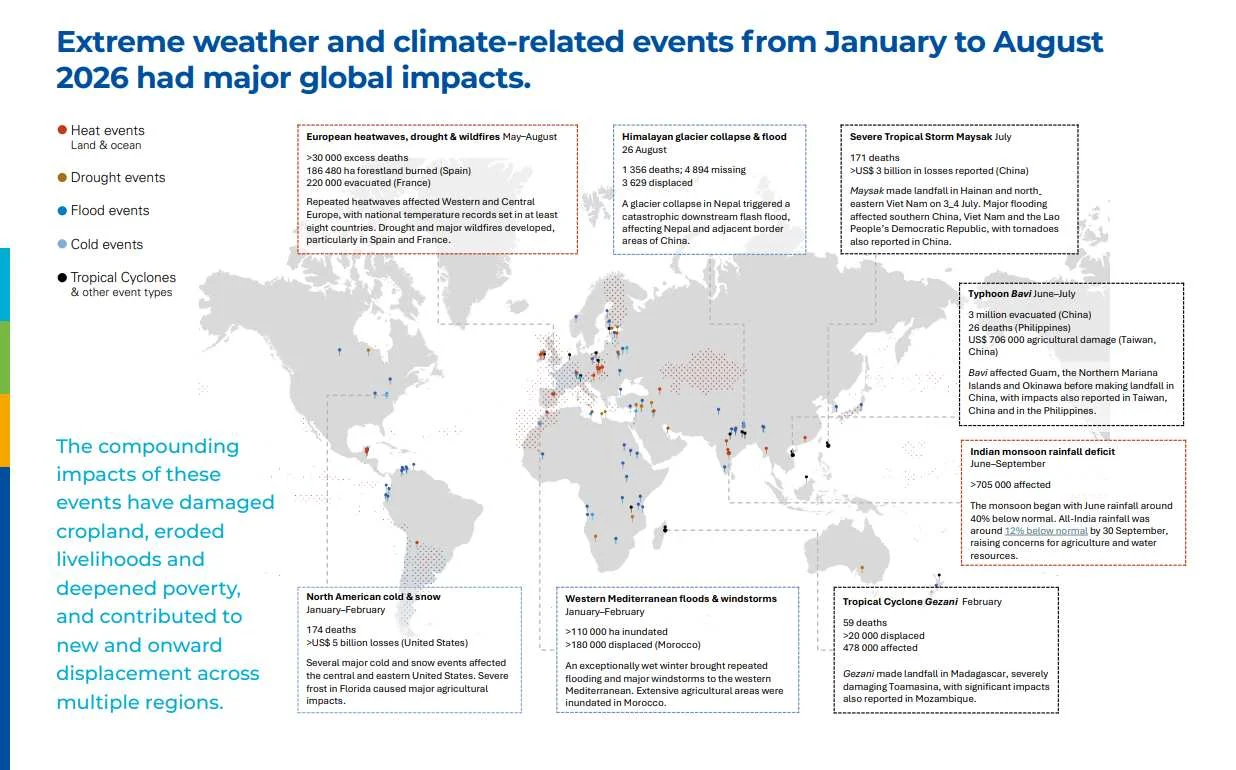
Extreme weather events caused severe global impacts between January and August 2026
Extreme weather and climate events have threatened lives and livelihoods, undermined food security, worsened poverty and contributed to forced displacement across many regions.
Heatwaves, drought and wildfires in Europe are estimated to have caused more than 30,000 excess deaths, according to preliminary estimates cited by the WMO.
Extreme heatwaves set temperature records in at least eight countries, with major consequences for agriculture, energy and transport.
An estimated 146.5 million people in India were exposed to extreme heat during the April 2026 heatwave.
The collapse of a Himalayan glacier and the resulting catastrophic flash flooding downstream in late August killed more than 1,300 people.
The disaster also had a devastating impact on Nepal’s already fragile economy.
Tropical cyclones also caused widespread destruction and loss of life in several countries.
Earth’s energy imbalance continues to increase
Measurements of ocean heat and satellite observations indicate that Earth’s energy imbalance is growing, with the planet accumulating heat at an accelerating rate.
In 2025, this imbalance reached its highest level since records began in 1960.
Preliminary data for January to July 2026 suggest that another record could be reached.
Ocean warming provides one of the clearest indications of Earth’s energy imbalance, as more than 90% of the excess energy is absorbed by the oceans.
In 2025, ocean heat content in the upper 2,000 metres reached the highest level ever recorded, exceeding the 2024 figure by 19 ± 11 zettajoules (ZJ).
Preliminary observations through July 2026 indicate that ocean heat content continued to increase.
Greenhouse gas concentrations reach record levels
Atmospheric concentrations of the three main greenhouse gases, carbon dioxide, methane and nitrous oxide, reached record levels in 2025, the latest year for which consolidated global data are available.
Atmospheric carbon dioxide concentrations were 53% higher than in 1750.
Global average methane concentrations increased by 167%, while nitrous oxide concentrations rose by 26% over the same period.
Terrestrial ecosystems exchange approximately ten times more CO₂ with the atmosphere than humans emit.
However, climate stress and water shortages can reduce their ability to absorb carbon dioxide, potentially turning some ecosystems from carbon sinks into carbon sources.
CO₂ absorbed by the oceans also changes marine chemistry, causing a long-term decline in surface ocean pH, which continued to fall in 2026.
Despite these alarming findings, Celeste Saulo also delivered a message of hope at COP31:
“Our collective efforts are delivering results. The number of countries reporting multi-hazard early warning systems increased from 56 in 2015 to 136 in 2025. This reminds us that progress is possible when we act together. COP31 needs to deliver urgent decisions capable of mobilising the financing required to address this existential threat that affects us all.”


