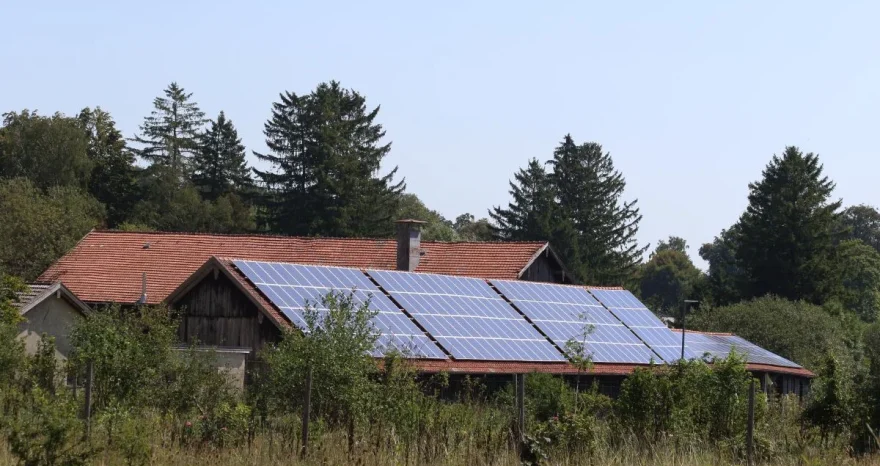
Global fossil fuel emissions are expected to decline by nearly 0.5% in 2026, as the Hormuz crisis pushes down oil and gas demand despite a renewed increase in coal consumption.

Fossil fuel emissions falling in 2026 by nearly 0.5% globally
Fossil fuel emissions are expected to fall by nearly 0.5% globally in 2026 as a consequence of the Hormuz crisis.
The conflict in the Middle East has severely disrupted trade flows through the Strait of Hormuz, driving up oil and gas prices and continuing to weigh on the global economy. The longer the war continues and new fronts emerge, including renewed tensions in Yemen, the greater the pressure on governments to shift towards alternatives to oil and gas. One of these alternatives is coal.
Higher global coal emissions more than offset by lower oil and gas use
The latest estimates suggest that global coal demand will increase by 1.2% this year as a consequence of the war in the Middle East. However, an analysis by Carbon Brief shows that the increase in global emissions associated with higher coal consumption, much of which is not linked to the disruption in Hormuz, could be more than offset by lower oil and gas use resulting from the war.
The analysis indicates that fossil fuel carbon dioxide emissions in 2026 will fall by around 0.5% compared with 2025 levels, while fossil fuels account for two-thirds of global greenhouse gas emissions.
The International Energy Agency (IEA) had initially estimated that global coal demand would decline in 2026. In its 2025 coal report, published in mid-December, the agency argued that falling demand in China would outweigh the impact of Trump administration policies supporting coal, resulting in an overall decline in global demand.
In its September 2026 update, however, the agency revised its outlook and projected that global coal demand will rise by 1.2% in 2026, rather than record a slight decline.
The IEA’s latest report also highlighted the role of El Niño, which is increasing cooling demand and reducing hydropower generation. Other factors are also affecting coal demand this year, including rising levels of curtailed wind and solar power in China.
Gas and oil demand decline
For natural gas, the IEA suggested in January 2026 that global demand would grow by 2% this year. By July, after several months of war in Iran, it was instead forecasting a 0.6% decline in global gas demand in 2026.
Since then, pressure on gas demand from high prices has continued to increase. In the first six months of this year, for example, China’s demand for liquefied natural gas declined. Concerns over security of supply have pushed Beijing to prioritise renewable energy, while imported LNG and coal account for an increasingly limited share of the country’s energy mix.
For oil, the IEA was still forecasting an increase in demand of 930,000 barrels per day (bpd) in January 2026. However, as the Hormuz crisis continued, the outlook changed significantly. In September, the IEA projected a further decline in oil demand of 2.5 million bpd in 2026, equivalent to a 2.4% reduction compared with 2025 levels.
The latest energy crisis, alongside several other factors, will continue to shape fossil fuel demand next year and potentially beyond. The IEA had initially expected oil demand to rise well above 2025 levels in 2027. It now expects demand to remain broadly unchanged for two years.
At the same time, electric vehicle sales have reached record levels across the world’s major automotive markets. The IEA has also highlighted the interdependence between coal and gas. Coal demand could rise again in 2027 if gas prices remain high, or decline if gas prices ease. In the United States, higher gas prices had already triggered a return to coal in 2025.
Governments in countries that had planned to rely on liquefied natural gas imports now appear more inclined towards locally produced clean energy, or towards using coal for longer than previously expected. This dynamic may also be relevant for African countries weighing imported fossil fuels against domestic energy resources, particularly where exposure to international fuel prices remains a concern.
Against this backdrop, the analysis concludes that the 2026 energy crisis could lead to a reduction in fossil fuel use and related emissions in both the short and long term.